

Talking Time: Navigating the World of Talking Watches
By John Marshall – Sight Cymru Digital Inclusion Officer

For those living with sight loss, whether recently diagnosed or navigating life with long-term visual impairment, something as seemingly simple as choosing a talking watch can feel surprisingly complicated. At first glance, it should be a straightforward task – after all, the modern world is overflowing with wearable tech. Our social media feeds are full of affordable smartwatches, while high-street staples like Sekonda, Casio, and Timex continue to produce their familiar classics. Even premium brands like Radley, Armani and Prada now offer smartwatches. Yet for someone with little or no sight, this apparent abundance hides a frustrating truth: very few of these watches are genuinely accessible straight out of the box.
This barrier is something the visually impaired community knows all too well. For those newly confronting changes to their vision, the search for independence can be daunting. The market is awash with tech that looks modern and promises cutting-edge features. Still, without accessible menus, tactile cues, or reliable voice feedback, many of these devices are entirely unusable. Meanwhile, those of us with established sight loss often have to navigate a confusing mix of outdated designs and inaccessible ‘fashion’ models that leave us feeling excluded.
Another common misconception is that our preferences are dictated by age – that older users only want a simple talking button, while younger people naturally gravitate toward the shiniest smartwatches. The reality is far more individual. A younger user might relish the tactile, retro simplicity of a one-button talking watch, while an older user might be eager to explore voice assistants and fitness tracking features.
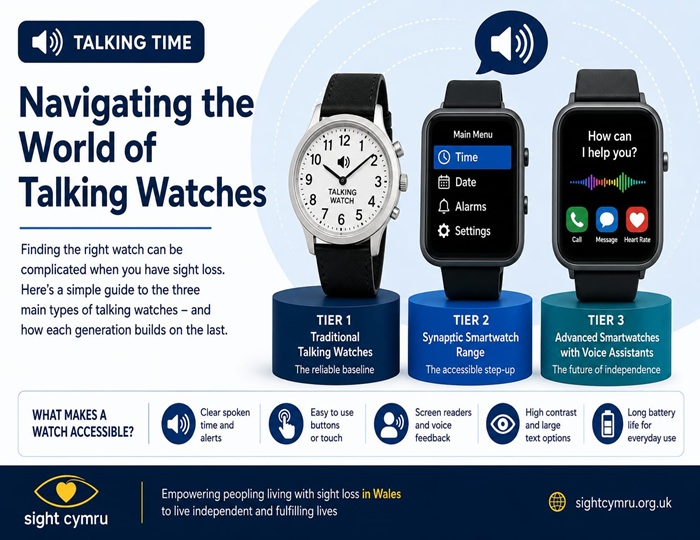
The real hurdle isn’t interest or need – it’s accessibility and practicality. The budget market is a minefield of trendy wearables that either completely ignore screen reader support or fail to provide tactile usability. Gaining true independence on your wrist requires careful navigation through three broad tiers of technology. Here’s how they compare, and how each generation builds on the last.
—
Tier 1: Traditional Talking Watches (The Reliable Baseline)
This is the starting point most of us are familiar with, sharing a lot of DNA with the classic one-button talking cube clocks we keep around the house.
The Baseline Features: It does exactly what it says on the tin, providing the absolute core essentials – telling you the time and date out loud, usually accompanied by a straightforward alarm function. Speaking of the alarm function, we have to mention the classic cockerel alarm tone – if you know, you know. It’s a hilarious truth of the visually impaired world that this exact, piercing rooster chime has featured on nearly every single talking watch ever made.
In addition, many Tier 1 watches feature high-contrast, large-number faces for people with residual vision, making it even easier to glance at the time without relying solely on speech.
The Limitation: While it’s beautifully uncomplicated, any contemporary style choices are practically non-existent. The designs in this tier have largely stagnated over the years, which is frustrating if you want a piece of jewellery that looks modern and sleek.
Tech Literacy Needed: Absolutely zero. It’s entirely tactile, mechanical and plug-and-play.
—
Tier 2: The Synapptic Smartwatch Range (The Accessible Step-Up)
The Synapptic range bridges the gap between old-school simplicity and modern smart technology, moving the functions of Tier 1 onto a digital touchscreen interface carefully designed for sight loss.
Both models in this tier feature customisable watch faces, allowing you to choose from high-contrast layouts, large fonts, or other visually accessible designs.
They also include built-in screen readers. These work by reading aloud whatever is shown on the screen, so as you swipe or tap on different items, the watch announces each option. This makes it possible to navigate menus, set alarms, and access apps entirely by audio feedback.
Synapptic Smartwatch LITE
The Features: This model takes the spoken time, date and alarm functions and presents them with a high-contrast, large-print touchscreen menu, complete with clear spoken audio feedback and the built-in screen reader guiding you through each menu choice.
The Limitation: Some users may find it basic if expecting a wide range of modern digital features. It is entirely touchscreen-driven without advanced voice control.
Synapptic Smartwatch PLUS
The Upgrade: The Voice Advantage: The step up to the Plus model introduces a game-changing feature: a built-in voice-controlled digital assistant. This allows you to bypass physical menus entirely, issuing voice commands to make calls, dictate texts, set timers, or adjust settings. The built-in screen reader complements this, giving full verbal guidance as you explore the watch’s menus and notifications.
Alongside the voice assistant, the Plus includes a dedicated suite of health monitoring tools. Thanks to a built-in heart rate monitor on the back of the casing, it tracks your daily steps, distance and calories burned, and even gives you gentle ‘movement reminders’ to keep you active. Because of the built-in SIM card slot, your voice commands can make calls and send texts directly from your wrist while you’re completely away from a mobile phone.
The Limitation: While standalone connectivity sounds like the ultimate freedom, it comes with a major real-world snag. Because the watch uses a physical SIM card, it requires its own separate data plan and its own separate phone number. Managing two different phone numbers can be a bit of a logistical headache. Your contacts have to save both numbers, and if they want to reach you, they have to guess whether you’re looking at your phone or just wearing your watch. It also means managing duplicate contact entries on your end, which adds an unnecessary layer of cognitive load.
—
Tier 3: High-End Mainstream Smartwatches (The Apple & Google Ecosystems)
At the top of the ladder sit the mainstream heavyweights, with the Apple Watch leading the charge for accessibility.
The Features: It naturally covers all the bases of the previous tiers – time, date, alarms, and advanced health tracking (including ECGs, blood oxygen levels and detailed workout metrics) – but weaves them seamlessly into your existing digital life. Like Tier 2, these watches support customisable faces, including high-contrast layouts and large-font faces for maximum readability.
Screen Reader Support: Tier 3 watches include highly advanced built-in screen readers, such as VoiceOver on the Apple Watch or TalkBack on Android devices. These narrate everything on-screen, from app names to notifications. By using gestures like swipes and taps, you can explore the interface entirely by touch, with the watch speaking each item aloud as you navigate.
The Voice Advantage: Just like the Synapptic Smartwatch Plus, Tier 3 mainstream watches feature fully integrated digital assistants like Siri or Google Assistant. A quick voice command lets you handle system settings, calls, messages and more, entirely hands-free.
The Seamless Advantage: This is where mainstream tech really shines over specialised devices. The cellular version of the Apple Watch uses an eSIM. While it still requires an extra monthly subscription fee from your mobile network, it shares the same phone number as your iPhone. There’s no dual-number confusion for your friends, no contact clutter and zero guesswork when someone tries to reach you.
The Limitation: They are undeniably expensive. Furthermore, you are heavily locked into the top two ecosystems (Apple iOS or Google Android) if you want to access reliable, top-tier screen readers like VoiceOver or TalkBack.
Tech Literacy Needed: Relatively high. Navigating a full mainstream smartwatch interface using a screen reader requires a bit of a learning curve and a fair amount of digital confidence.
—
The Final Takeaway
When we look at the evolution of accessible timekeeping, it really comes down to a personal trade-off between simplicity, cost and everyday convenience:
- If you want total simplicity and zero fuss, traditional watches are still fantastic, even if the styling feels a bit dated (and forces you to face the rooster every morning).
- If you want a voice-assistant-driven experience, health tracking and dedicated software without needing a phone nearby, the Synapptic Smartwatch Plus delivers beautifully – provided you don’t mind the quirkiness of managing two phone numbers.
- If you want a highly contemporary, voice-controlled, seamless experience where one number rules all your tech and monitors your health flawlessly, the Apple Watch takes the crown – assuming you have the budget and the tech confidence to get the most out of it.
If you’re still searching for personalised guidance on finding the perfect talking watch, call us on 01495 763650 or visit our Contact Us page and speak to our Resources or Digital Inclusion teams. They’ll be more than happy to provide tailored advice.